
Proceling Bushing for Transformer
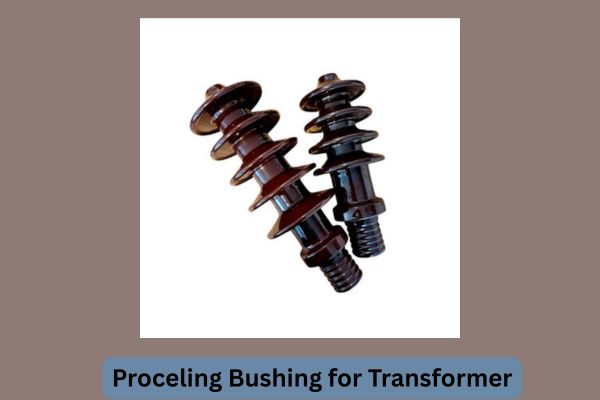
In electrical engineering, a transformer bushing is an insulated device that allows an energized, current-carrying conductor to safely pass through the grounded metal tank of a transformer without shorting out.
Among various insulation options (like epoxy or silicone rubber), porcelain remains the global industry standard for outdoor and high-voltage applications due to its incredible mechanical strength, environmental durability, and resistance to electrical tracking.
Why Use Porcelain?
High-grade electrical porcelain (often enriched with alumina, such as C120 or C130 grade) offers distinct physical advantages over synthetic materials:
- Inert and UV Stable: Being inorganic, porcelain does not degrade, discolor, or crack under harsh, continuous sunlight.
- Hydrophobic Glaze: The smooth, glass-like brown or gray outer glaze prevents water from pooling and forces rain to wash away environmental dust, salt, and industrial pollution.
- High Compressive Strength: It can handle the immense structural stress and weight of heavy high-voltage overhead cables pulling on the terminal.
Key Design Features & Anatomy
1. The Conductor (The Core)
Running directly down the center of the hollow porcelain tube is a solid copper or aluminum rod (or a draw-through cable). This carries the full electrical current from the overhead transmission lines into the internal windings of the transformer.
2. “Sheds” or “Skirts” (The Corrugations)
The most recognizable feature of a porcelain bushing is its wavy, umbrella-like disks. These are called sheds or skirts, and their layout is mathematically engineered:
Maximizing Creepage Distance: Electricity wants to travel across the outer surface of the insulator. The sheds increase the total surface path length (creepage distance) without making the bushing awkwardly tall.
Creating Dry Zones: During heavy downpours, the underside of each shed stays dry. These sheltered, dry zones act as critical barriers that break up continuous paths of conductive water sheets, preventing a catastrophic flashover (an explosive electrical arc through the air).
3. Mounting Flange and Gaskets
Where the porcelain meets the metal transformer tank, a metallic mounting flange is securely bolted down. Because transformers expand and vibrate during operation, high-performance rubber gaskets (typically Nitrile for standard mineral oil or Viton for high-temperature applications) create a hermetic seal to prevent transformer oil leaks and stop moisture ingress.
Types of Porcelain Bushings by Voltage
Depending on the operational voltage, the internal construction of a porcelain bushing scales in complexity:
- Solid / Bulk Bushings (Low to Medium Voltage: 1.1kV – 36kV: A simple, hollow porcelain shell where the central conductor is insulated entirely by the porcelain body and the surrounding air or transformer oil.
- Condenser Bushings (High Voltage: $>52\text{ kV}$): At higher voltages, the electrical field stress becomes too intense for raw porcelain alone. Inside the porcelain shell, layers of paper insulation interleaved with concentric aluminum foils are wound around the central rod. This creates a chain of capacitors that evenly distributes the intense voltage stress radially and axially across the device, preventing localized insulation puncture.
Maintenance and Vulnerabilities
While porcelain is highly durable, it has one major weakness: it is brittle. Hairline cracks caused by improper mechanical lifting, over-tightened bolts, or flying debris can allow moisture to seep inside, leading to partial discharge and eventual explosive insulation failure. Routine visual inspections, thermal imaging, and dielectric testing (tan-delta measurements) are standard utility practices to ensure they remain intact.